
The day has finally arrived!
You’re ready to launch your site off into the endless expanse of the internet. You content is polished and beautiful, your site delivers an amazing user experience—after all, there’s no point in driving traffic to a site that no one will like!
You wait, ready to answer any comments, thank everyone who shares your content—and spend all day refreshing your site stats, as a tiny trickle of people come and go, with barely a word to say.
It doesn’t have to be this way. Sure, everyone starts at the bottom, but that doesn’t mean you must start at zero. There are ways to make sure your reach is as large as it can be from that first day—and the faster your start, generally, the faster your rise.
So how do we go about making sure your site has the absolute best debut it possibly can?
Assess Existing Assets
Starting Big
You probably recognize the name Neil Patel. If not, he cofounded Kissmetrics, and has since created several very successful blogs. He clearly works harder than most people, and he knows his trade, so chances are good he would have found success regardless of his base. That said, the name recognition, authority, and readership he gained from working here on Kissmetrics probably didn’t hurt, right?

Chances are your first article won’t generate 12,577 views the month you launch your site.
The bigger you want to build a skyscraper, the wider and deeper you have to design the base. Likewise, if you want to build a huge following quickly, the best thing to do is to start with as many people as possible looking at you.
Starting out, you probably don’t have a blog with hundreds of thousands of subscribers to pull from, but that doesn’t mean you don’t have anything at all.
Today, almost everyone is active on some sort of social media, and most of those who aren’t make up for it by having friends out there in the real world. It’s worth saying, don’t be obnoxious about it, but most of your friends and acquaintances well be happy to give you a boost if you ask them. Your primary goal out the gate is to get people signed up to your email list, because that will bring people back, and your secondary goal is to convince them to share your content, because that will bring new people in. Even a few dozen or hundred people will make a big difference in the short run. We’ll get into why in a minute, but for now let’s talk about how.
Where to Amass Followers
First off, if you aren’t familiar with the ins and outs of conversion, it would be a good idea to read up a bit. Your goal here is to create that wide base to build off of, so you get the most out of every post. Different networks offer different advantages, and you can certainly, if you don’t have time for setting up and growing all of them, mix and match to focus on those aspects you believe will be the most important to your specific situation.
Facebook Friends
Facebook is great for starting a site out, especially your first, because they let you invite people to join your business/fan page, where you’ll hopefully have a nice conversion button to take them to your site. User engagement with your posts is higher on some other platforms, but no one else lets you bug people in quite as direct and friendly a way as Facebook. Better yet, people are used to getting invited to random things, so they’re not going to hold it against you.
Likely you’ve already seen the big problem with this, though, which is the nature of your social network on Facebook. Simply put, your friends, family, and acquaintances are not likely to be your actual target market. That’s okay, because, hopefully, a few people in their networks are.
Don’t underestimate the value of joining Facebook groups in your target area, either. These are often very active, but overlooked and underutilized by major players, meaning you only have to compete with other little fish for attention. With any luck, you’ll make some new friends struggling with the same issues you are, and help each other grow into medium-sized fish.
Twitter Followers
Twitter is a fickle beast. Unless you’re very good or very lucky, you will probably see only a trickle of traffic from this site. Even tweets that do very well from a retweeting perspective tend to have low conversion.
Somewhat ironically, given that it’s such a large and impersonal site, what Twitter is best used for early on is building relationships. Follow and reach out to established authorities in your niche. Not only are you genuinely likely to have interests in common, but many are happy to offer advice and support, and a single share of your content from a known authority can open you up to dozens or hundreds of new connections.
To put it another way, your focus on Twitter isn’t bringing floods of people to your site, it’s about bringing a handful of the right people.
Google Plus
Google Plus is another oddball. It might be important for SEO rankings, you need a profile on it, but it’s so convoluted in some respects that it’s hard to grow yourself there. One particularly great thing about it is that anything you share on G+ is almost instantly indexed.
I don’t know entirely why Google Plus is such a mess. Part of it is no doubt the learning curve for G+; while most social media platforms have a clear and obvious thing they do, G+ is trying to be everything to everyone. They want to handle the comments on your blog, they want to merge with your YouTube channel, and so on, so it’s not clear entirely what you’re there for at first glance.
Most of the people who use it fall into one of two categories:
Power Users: These people really get a lot done with G+. They’ve taken the time to figure out how to take advantage of its strengths, and they’re reaching other experts. This, oddly, makes G+ a great place for interacting with other people who are serious about what they’re doing.
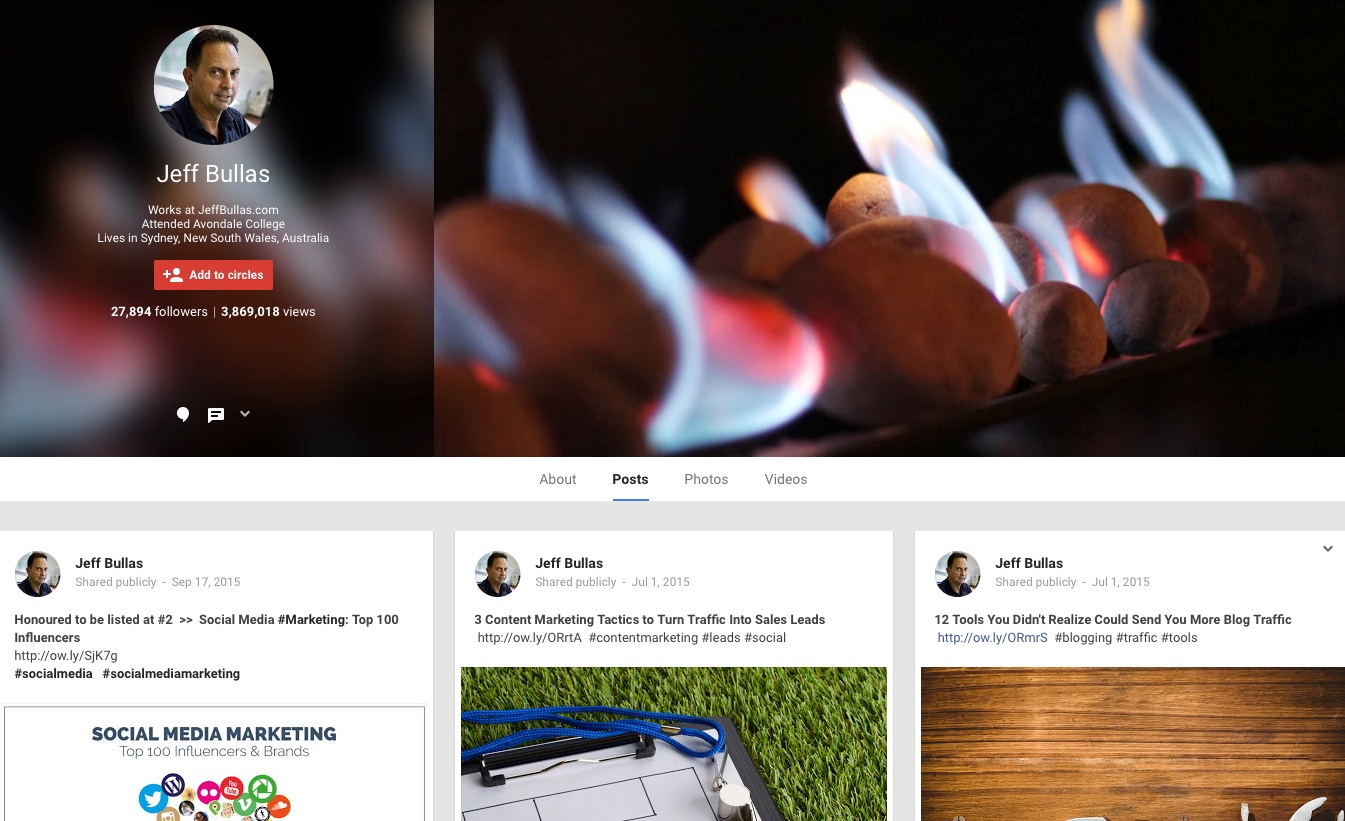
Jeff Bullas’ Google+ profile has almost thirty thousand followers and is closing in on four million views.
Autoposters: These people set their blogs to autopost to their G+ page and have never, ever, been back. This is almost everyone who could be described as a beginner, novice, or casual blogger.
In other words, most people either get a lot from it, or nothing at all. If you’d like to jump into getting the maximum from Google’s own take on the social network, start with the basics, and work out from there.
Pinterest and Instagram
This is a wildcard. If you are operating in a visually engaging niche, Pinterest and Instagram are both incredibly powerful. If you happen to be able to create small montages of eye-catching images, Instagram is possibly the easiest social media network to gain a big following on.
Pinterest doesn’t amass followers as quickly, but has been show to have a high conversion rate compared to most other social media platforms. In other words, if you can get people to look at your stuff on Pinterest, there’s a relatively high chance they’ll follow it to your site.
On the other hand, if your niche doesn’t lend itself to pretty pictures, these sites will be of somewhat diminished value to you. It’s also important to note that while both Instagram and Pinterest rely primarily on visual content, they are not created equal. Pinterest is a great place to share infographics and other more complex posts, while the structure and culture of Instagram reward collages and photographs more strongly. Including infographics in your articles is a great way to expand the reach of your content on that platform.
LinkedIn has been making big, and very overdue changes lately with how they deliver content. It now functions as something of a hybrid of Facebook’s News Feed and Tumblr, where you have a feed delivering content generated or shared by people you follow, as well as items LinkedIn thinks you might like – or was paid to show you.
One aspect which has not yet been overhauled, but is hopefully on the list, is the groups feature of LinkedIn, which is reminiscent of the forums that have existed on the internet since nearly the beginning. Like-minded people can gather together, create topic threads, and discuss those topics, to their hearts’ content. It should be an extraordinary tool for outreach to your target market, but in its current iteration is just a kind of okay one. By posting often, and linking to good content (yours and others’) you can usually bring in a pretty steady trickle of new people, with a relatively high conversion rate to subscribers, since they’re already interested in what you’re talking about.
The good news is that LinkedIn is the absolute easiest network to grow your network on. Everybody is there to, digitally speaking, exchange business cards.
The first step to creating a big following is to contact people you actually know. LinkedIn will then help you out by importing your contact lists and so on. You want to get about one hundred followers, so you look like a real person rather than a bot. Of course, one hundred people is way too small a number to really expand the reach of your content, so you’ll want to acquire more followers.
What should you do next? Well . . . This is sort of bad form, so don’t tell anyone I told you to do this, but what you should do is use the “People you may know . . .” feature to send out invitations to connect to as many people as you can. Target peers in your field in and your target audience—you want shares from the former and clicks from the latter.
Once you have five hundred friends on LinkedIn, your count simply shows as 500+ and you never have to send out a request again to grow your network, because you’ll get a steady stream of requests indefinitely.
Is this abusing the system a bit? Absolutely. Is it the best way to get something valuable out of LinkedIn? As far as I’ve been able to tell.
Other Websites
One of your biggest assets isn’t social media at all. Do you have any friends with blogs or websites? Acquaintances? Cousins of friends of friends?
Ask them to link to your new site, even just a mention. This will help you rise through the SEO page rankings by growing your domain authority.
If they have a more popular site, this can really translate to a huge bump.
Guest Posts
Even better than a link, reach out to people and ask for a chance to guest post. Many sites will be happy to extend at least the opportunity, and if you do it far enough in advance, they’ll be happy schedule the articles for your site launch or soon after. This is a three-fold win for you. It raises your domain authority, and it sends people your way, which is great. The big thing it does, though, is give you an opportunity to interact with the users of the other site, answer their questions and create rapport.
In fact, commenting on other blogs and websites is another great way to gain followers!
Many of the people you interact with (assuming the interactions are positive) will check out your own site. Even if they don’t, though, they’ve got one more reason to remember your name. If you’re showing up on a number of sites, they’ll see you again and again, and they’ll start thinking of you as someone whose advice is sought. An authority. Someone to pay attention to and follow.
Just remember to write insightful comments. Generic comments like “hey great post” won’t help. Since a lot of commenting systems allow readers to rank (thumbs up/down) comments, it becomes even more crucial to write something that will get the attention of readers. If you have nothing to say, don’t write anything.

Here, a commenter makes an insightful comment on a post from Both Sides of the Table. Reading his comment, it’s clear that he read the post, understood the content, and was able to make a useful insight.
There is some debate over whether the value of guest posts is deteriorating, but they certainly remain invaluable to sites in their early stages.
Don’t be afraid to ask
How do you get guest posting opportunities? You ask. Ask on Twitter or through email. However works, but do ask. Most sites, even relatively low traffic ones, get many, many, requests for guest blogging opportunities, but if they know you’re a real person, and you can show them you’ll do a good job, then at least a few of them will likely acquiesce.
This isn’t about taking the internet by storm, it’s about opening a door. As your name recognition increases, you’ll get more opportunities—that’s a long term concern though, and we’re talking about putting eyes on the page on day one. What you’re doing by guest blogging is diverting a tiny portion of as many larger sites’ traffic as you’re able to towards your own site. Many small streams make a river.
It should probably go without saying (but won’t) that your social profiles should be polished. You want to be wearing the digital equivalent of a nice suit, so that you look professional. Perfect formatting and grammar are necessary. The picture you choose is also important – people will judge you by this. Choose a professional photo – something you’d put on a resume.
Why Leveraging These Platforms Matters
I did promise to tell you why all this matter. Well, in all honesty it’s not critical that this all happens on day one. That’s just what this article is about, and there’s no reason you can’t have it all ready to go, so why wouldn’t you?
Blog growth tends to be happen slowly, if the blog’s doing well. You have ten in month one, twenty in month two, forty in month three, and so on. Give or take, of course, there isn’t some industry-standard growth curve. That said, you’ll have some average rate of conversion of visitors, and the more visitors you convert, the more visitors there will be to convert, so things gain steam. In other words, if you’re going to grow at all, in two or three years it won’t really matter whether you started with one subscriber or one hundred, because you’ll have thousands. However, there’s a big difference between a three month growth curve starting with one, ten, and one hundred followers.
Let’s look at a very simplified growth rate of 10% per month for twelve months.
Starting with ten followers, you’ll end the first month with thirteen, and the year with thirty-three. Starting with three hundred thirty. The math on this isn’t exactly hard. At this arbitrary growth rate every subscriber you have at the start is an extra tenth of a follower each month.
Does it really work this way? Of course not! This example is simple, and reality doesn’t have time for simple. Your growth will probably follow something close to this pattern at first, after that, things get complicated. At some point you’ll hit plateaus or viral spikes, and there will be good months and bad.
The point is, the more people you start with, the faster you’re going to grow if you’re doing everything else right. And that’s why we care about starting strong.
Followers are just the start, though, because, “. . . if you’re doing everything else right,” is a very big if.
Test All Tech
You’re going to have some technical difficulties. It’s going to happen. Still, it’s better if you don’t shoot yourself in the foot at the start of the race.
Technical difficulties can break a launch, and often do
Make sure everything is working. I can’t give you a real checklist for this, because it’s a big, complex topic, and since there are so many ways to build, host, and run a site, anything specific I wrote would be 90% irrelevant to everyone who read this. That said, there are some basic items which should be in the forefront of your mind.
Make sure your site works for all major browsers
Even Internet Explorer. There are very few things more frustrating when designing a site than making something very cool and discovering that it works in Chrome, Safari, Firefox, and . . . not Internet Explorer, because if one browser is messing up, it’s always Internet Explorer. IE is still the browser of choice for about 10% of the internet (which is millions of people). So, if you don’t support it, that’s ten percent of your potential market, poof, gone. Maybe that’s worth it to you, maybe it’s not, but be aware.
Ensure Everything Works Properly on Mobile
More and more people are visiting sites from mobile devices, so it’s very important to make sure your site renders properly on these devices. If they have to pinch and zoom or try to adjust your site so that it is readable, it will leave a bad impression and most visitors will likely leave and never come back again. Even worse, it hurts your SEO with Google. Use Google’s mobile friendly test to make sure your site works properly.
Get Open Graph Working Correctly
You know when people share an article on Twitter, LinkedIn, and Facebook and there’s a catchy image that appears? That’s no accident. Their Open Graph is working properly.
Make sure key features work
Like I said, I can’t really give you a definitive guide, but there are some critical growth opportunities that you’ll lose if you don’t have the following features working: comments, follow, share, and subscribe.
Fully Integrate Your Social Media Platforms
Speaking of following and sharing, since you have gone to the trouble of growing your potential readership through social media from the outset, it would probably be a good idea to make sure your site can properly leverage these media. This is another good reason to grow your following in advance, as you’ll have to set up the various accounts to connect them to your site anyway.
Make sure all the buttons work. Seriously.
So speaks the voice of painful personal experience! Make sure every single button you have on the site actually does what it’s supposed to be doing. Don’t just assume it will.
Make it Easy For Users To Give You Their Email Address
Remember, the prize bit of user engagement (aside from actual sales) is the email subscription. You don’t want users to leave without giving you their email. Look at Kissmetrics. What’s the first thing you see in the top left, right where your eyes look when you start reading the page? A box for your email and name . . . and this is a site which is all about the science of conversion. What does that tell you about how important email subscriptions are?
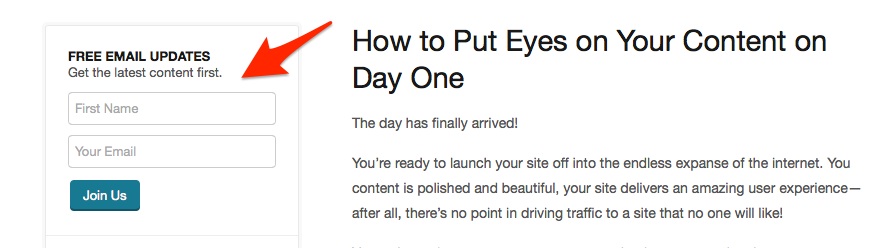
Easy signup process
So make sure they can give you their email address! Any funnels you have for convincing people to give them to you are well constructed, but also don’t put up any barriers; if the user wants to skip your pitch and just commit, don’t force them to click through a million reasons why they should do exactly what they were already planning to do.
And make it clear what they’ll be getting when they sign up. An email every time a new post goes live on your blog? Will this be everyday, a few times a day, once a month, etc? Make it very clear before they signup. And, of course, tell them that you’ll never spam them (assuming you won’t).
Ensure all content is optimized to share easily
This is another tricky one, because “optimized to share” is different for different platforms, and, also, changes for each platform from time-to-time. While individual platforms change what sizes and types of content look best only rarely, with all the platforms out there, it’s a pretty constant trickle.
What you want to consider are the sizes of the images, the length and content of your excerpts, and the length and content of your titles. There are other aspects to consider, but basically you should put some real though into making people want to click on whatever stub you’re showing them.
Keeping track of those details is a huge headache, but luckily there are sites dedicated to doing just that.
Observe Some Simple Best Practices
There are a few more miscellaneous things you can do to really maximize your return on investment right at the start, simply by avoiding missteps.
Don’t include content which will anger people unless that’s what you’re going for.
Making people angry is actually a great way to make money, judging by the number of big sites which seem to specialize in it. That said, don’t do it accidentally. What a mess that is. Just think before you post.
Don’t get too fancy
Bells, whistles, buttons, video intros, etc. There is always a new next big thing, and it’s okay to indulge now and then, but you should, especially right at the start, be focusing on strong fundamentals. You look better sinking one from the free throw line than barely missing ten from the half court.
Don’t mislead
Honesty, honesty, honesty. If people don’t trust your brand, you are sunk. You’ll be shopping for office space on the lower deck of the Titanic. So don’t be sketchy. Even if it pays off immediately, it will hurt you in the long haul.
Don’t Spam
People are trusting you with their time, their contact info, and their attention. Don’t abuse it, simple as that. Treat their time as your own. If you’re good about it almost all the time, most people will forgive you when you slip up.
Project Professionalism
This is sort of an extension of everything above. Perception is important. If you want to look like a business authority, maybe use an “about me” photo featuring yourself in a type of suit that doesn’t begin with any of the following words: swim, jump, gimp, or birthday.
An exception would be the word “space”. If you’re an astronaut, play that up.
Have a Post Bank Saved Up Prior to Launch
Start Your Organic Rise
Okay, let’s touch on the organic search results, because you should start building your domain authority right at the start. We’ve already mentioned how to position yourself to squeeze out lackluster competitors, but there are a few more things to consider.
Ensure your content is at or above the quality of top competitors in your niche.
I won’t go into this too deep, because everyone who’s even sort of an expert in internet marketing and SEO has already written an entire post on it, but the best way to rise in your niche rankings is to find searches where the top result is mediocre or worst, and answer the same question better.
Write several articles on topics related to your niche.
You want to have several articles, perhaps half a dozen, populating your site right at the word go. This way, anyone who arrives has few things to read or share—and, better yet, link back to. But take your time with writing. To write something truly insightful and useful is a lot of work. Quality over quantity.
Establish (and Keep) a Schedule.
One of the biggest predictors of whether or not a site will grow is whether or not someone keeps creating new content on a schedule. Now, this probably isn’t a perfect correlation, because the people who are busy creating content are also the people who are going to be working hard at all the other aspects of making a site fly.
Advertising
How much depends on your budget, but let’s be honest here, advertising is still an amazing way to bring people in, and expand your reach. Services like Outbrain are specialized for content.
Always Be Learning
Creating great content that gets shared and has great SEO is tough. It requires a lot of learning and practice. Don’t expect to know it all from the start. Begin with reading Google’s Webmaster Guidelines. Read it and live it.
It’s also worth reading up on Bing’s guide to building quality content and even Wikipedia’s guide to writing.
Additionally, spend time learning why other sites rank well and are well-respected. What do the New York Times, The Atlantic, and even Pitchfork have that gets them the respect, authority, and traffic? Know what makes good content and what makes bad content.
Conclusion
This is all a lot of work, I know. Running a site is a lot of work.
Momentum takes awhile to accrue—that’s both the pleasure and the pain of it, but, generally speaking, if you follow these guidelines, you’ll have tilted the ground in your favor. All you have to do now is push as hard as you can, as long as you can, to take advantage of the friendly terrain. There’s no road to easy success, because, if the road is easy, you’re going to get lapped by all the people giving it their all.
What advice do you have to help people put eyes on their content from day one?
About the Author: Anja Skrba has been blogging for over five years. You can find her at FirstSiteGuide.com whereshe shares tips on blogging basics and trends.
 😍AFFORDABLE DEAD DEER REMOVAL - DEAD ANIMAL REMOVAL SERVICES NJ😍